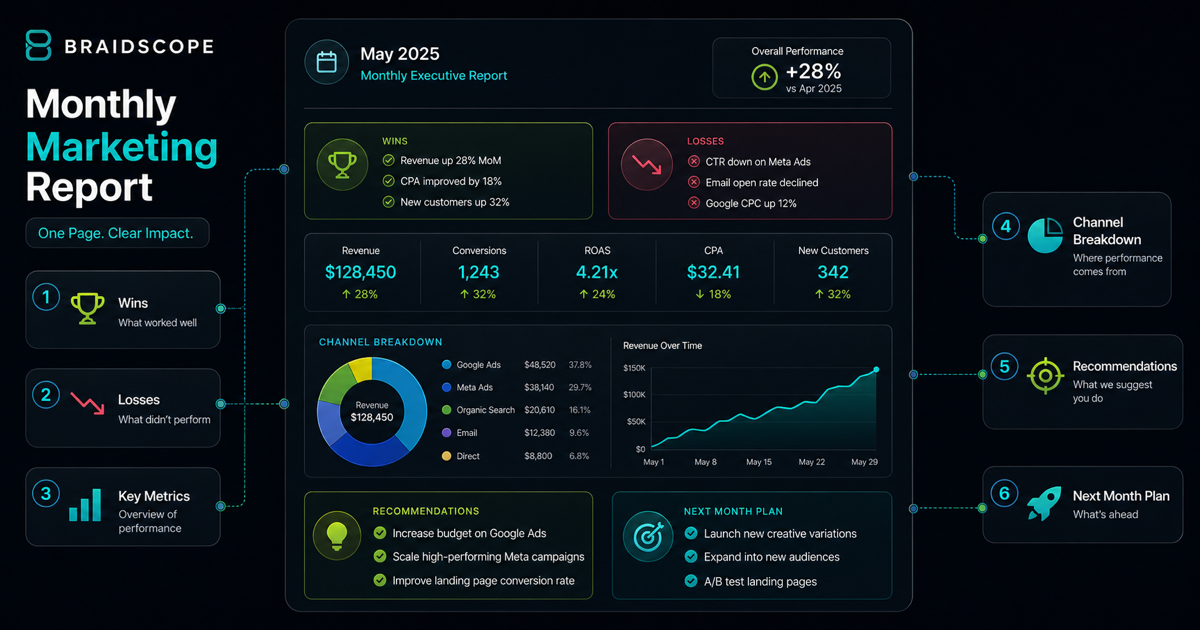
Most monthly marketing reports are too long.
They try to prove the agency did work, so they include every campaign, every chart, and every metric. The client opens the report, scrolls for the one number they care about, and then asks the same question in the next meeting.
A better monthly report is shorter, sharper, and built around decisions.
Quick takeaways
- A monthly report should help the client make decisions, not prove every task happened.
- Start with wins, what changed, why it changed, and what happens next month.
- If it takes more than an hour to prepare, the reporting system probably needs automation.
The reader is busier than you think
Assume the reader is checking this between meetings.
An agency owner wants the report to show competence. A founder wants to know what to fix. A business leader wants the result and the risk. A normal client wants plain English.
That means the monthly report should not make the reader work hard to find the point.
Why monthly reports fail
Monthly reports usually fail for three reasons.
First, they show too much data. More data does not create more trust. It often creates more confusion.
Second, they do not explain context. A metric going up or down only matters if the client understands why.
Third, they do not include a recommendation. If the report does not tell the client what happens next, it is only a receipt.
The goal is not to document everything. The goal is to help the client understand performance and approve the next move.
Use a one-page executive summary
Every monthly marketing report should start with a one-page summary.
Use this format:
- What happened this month
- What changed versus last month
- Why it changed
- What we recommend next
- Any decisions needed from the client
This page is the report. Everything after it is supporting detail.
If the client reads only the first page, they should still understand the month.
Section 1: Wins
Start with the wins, but keep them tied to business outcomes.
Good wins:
- revenue increased 18%
- cost per lead dropped 22%
- organic conversions reached a new high
- email revenue recovered after list cleanup
Weak wins:
- launched new campaigns
- published more posts
- increased impressions
- built a new dashboard
Activity can support the win, but it should not be the headline.
Section 2: What changed
Clients care about movement.
Show what changed compared to the previous month:
- spend
- revenue
- leads
- conversion rate
- ROAS
- traffic quality
- pipeline value
Do not show every metric. Pick the ones tied to the client’s goal.
Section 3: Why it changed
This is where most reports become useful or useless.
If revenue dropped, explain why. If leads increased, explain where they came from. If ROAS improved, explain whether it came from better conversion rate, lower CPC, stronger creative, or higher AOV.
The client may not agree with every conclusion, but they will trust that you are thinking.
Section 4: What we are doing next month
Every monthly report should include the next plan.
Examples:
- shift budget into the best converting campaign
- refresh creative to reduce fatigue
- fix tracking gaps before scaling spend
- test a new landing page offer
- create SEO content around converting search terms
This section turns reporting into strategy.
Metrics by channel
For paid media, include spend, clicks, CTR, CPC, conversions, cost per conversion, revenue, and ROAS.
For SEO, include organic sessions, search impressions, ranking movement for tracked keywords, organic leads or revenue, and key page performance.
For email, include revenue, open rate, click rate, conversion rate, unsubscribe rate, and campaign contribution.
For social, include reach, engagement rate, link clicks, profile visits, conversions, and assisted revenue where available.
For ecommerce, include revenue, orders, AOV, conversion rate, ROAS, MER, and top products.
If you serve ecommerce brands, the ecommerce agency use case is a good reference for how Braidscope thinks about combined Shopify and ad reporting.
How long should it take?
If a monthly report takes more than one hour to prepare, the reporting system is broken.
The data should already be pulled. The dashboard should already be updated. The account manager should spend time on analysis, not screenshots and copy-paste work.
That is the difference between reporting as a manual chore and reporting as a client communication system.
Add a decision box
Every monthly report should have a short decision box:
- Decision needed: yes or no
- Recommended action
- Expected impact
- Risk if ignored
This helps leadership use the report instead of just reading it.
Automate the data, not the judgment
Automation should handle:
- data collection
- dashboard updates
- report delivery
- recurring summaries
- basic anomaly detection
Humans should handle:
- interpretation
- client-specific nuance
- recommendations
- difficult conversations
Braidscope is built around that split. It automates dashboards and delivery, then gives your team plain-English AI answers so they can write better summaries faster.
Bottom line
A monthly marketing report should be short enough to read and useful enough to discuss.
Lead with the summary. Explain the movement. Recommend the next move.
If you want to stop manually pulling monthly reports for every client, join the Braidscope closed beta and lock in founder pricing before launch.