Paid media agencies do not need more tools. They need fewer manual handoffs.
The right stack helps your team launch campaigns, monitor spend, explain performance, and report to clients without living in exports and spreadsheets.
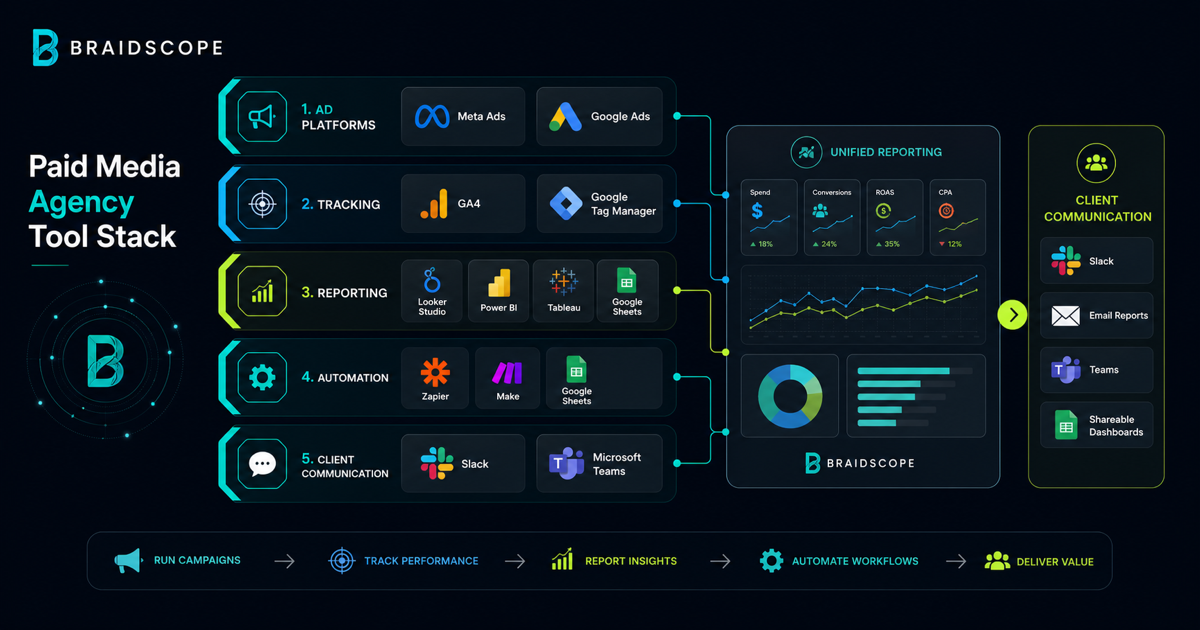
Here is the practical paid media agency stack for 2026.
Quick takeaways
- A paid media stack should reduce handoffs, not create more logins.
- Native ad platforms are for campaign control, not client-facing reporting.
- Most agencies underinvest in reporting even though it is where clients judge budget control.
What the stack should do
The best stack does not impress the team with more logins. It removes friction.
For an agency owner, it should protect margin and make account quality consistent.
For a founder, it should show what is working without needing a media buyer beside you every day.
For a business leader, it should connect spend to revenue, leads, or pipeline.
If a tool does not help with one of those jobs, it may not belong in the stack.
Category 1: ad management
You still need the native platforms.
For most agencies:
- Google Ads
- Meta Ads Business Manager
- LinkedIn Campaign Manager for B2B
- TikTok Ads for some ecommerce brands
Native platforms remain the source of campaign control.
The mistake is using them as the client reporting layer. Clients do not need to see every campaign setting.
Category 2: reporting and dashboards
This is where many paid media agencies underinvest.
Options include:
- Braidscope
- AgencyAnalytics
- Looker Studio
- DashThis
- Whatagraph
Braidscope is best for agencies that want flat-rate pricing, automatic dashboards, and AI answers across multiple clients.
AgencyAnalytics is mature, but pricing grows with client count.
Looker Studio is flexible, but someone has to maintain it.
For a deeper breakdown, read AgencyAnalytics alternatives.
Category 3: attribution
Attribution depends on client type.
For ecommerce, use Shopify, GA4, platform attribution, and sometimes Triple Whale or similar tools.
For lead generation, use GA4, CRM data, call tracking, and qualified lead status.
Do not rely only on ad platform attribution. It is useful, but it is not the full truth.
Category 4: client communication
Slack is useful for weekly reporting pulses and quick decisions.
Loom is useful for short walkthroughs when performance needs explanation.
Email still works for monthly reports and executive summaries.
The key is consistency. Clients should know where updates arrive.
Category 5: automation
Automation tools like n8n or Zapier are useful for internal workflows.
They can send alerts, move data, update sheets, and trigger notifications.
But do not build a fragile reporting system out of dozens of small automations unless someone owns maintenance.
Braidscope is designed to make reporting automation native instead of stitched together.
What paid media agencies overpay for
Agencies often overpay for tools that add visual polish but do not reduce reporting labor.
A prettier dashboard is not enough if the team still spends hours interpreting and sending reports.
What paid media agencies underinvest in
They underinvest in reporting systems.
Reporting is where clients decide whether the agency is managing spend responsibly. If the report is late, confusing, or manual, trust drops.
Read the paid media agency use case for how Braidscope frames this workflow.
The lean stack
For most paid media agencies, the lean stack is:
- native ad platforms for campaign management
- GA4 or store data for source-of-truth outcomes
- a reporting layer for client visibility
- Slack or email for recurring updates
- Loom for occasional narrative walkthroughs
You do not need ten tools. You need the right handoffs between the few tools that matter.
Bottom line
The best paid media agency stack gives operators control and gives clients clarity.
If reporting is the bottleneck in your paid media agency, join the Braidscope closed beta and lock in founder pricing before launch.