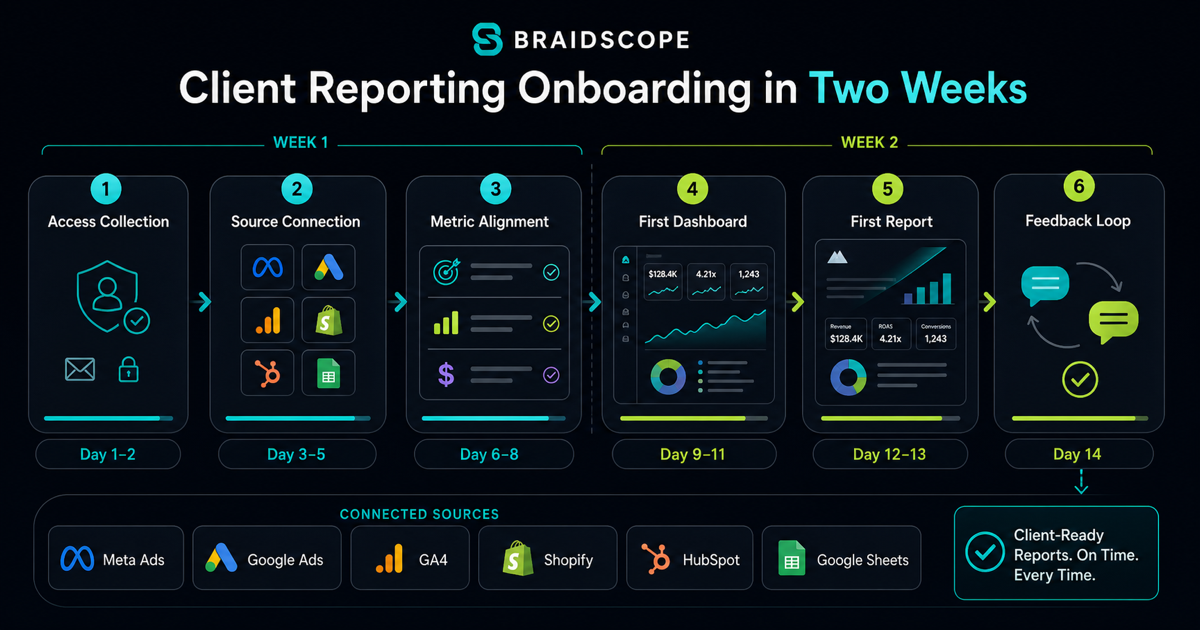
The reporting relationship is set in the first two weeks.
If goals, metrics, access, and cadence are unclear at the start, every report later becomes harder. The client questions numbers. The team chases access. Nobody agrees on what success means.
Good reporting starts during onboarding.
Quick takeaways
- Reporting trust is created in the first two weeks, before performance has had time to improve.
- Agree on goals, metrics, cadence, and source of truth before the first report goes out.
- The first report should establish a baseline, not pretend to prove success.
The owner-level problem
Agency owners often think onboarding is about getting access and launching work. That is only half of it.
Onboarding is where you teach the client how to judge the relationship.
If you do not define the reporting rhythm, the client will invent their own. They may check the ad account at random, compare the wrong date range, or judge SEO after two weeks. Then your team spends the rest of the retainer correcting expectations.
For founders managing their own marketing, the same lesson applies internally. If you do not decide which numbers matter before you start campaigns, every dashboard becomes a source of anxiety instead of clarity.
Week 1: collect access
Start with access.
For most clients, you need:
- Meta Ads
- Google Ads
- GA4
- Shopify where relevant
- HubSpot or CRM
- Google Sheets or tracking docs
- Search Console for SEO
Do not wait until the first report is due to request access.
Week 1: agree on goals
Ask the client:
“What does a good month look like to you?”
This question is simple, but it reveals the real expectation.
The answer may be more leads, better lead quality, lower acquisition cost, higher revenue, better reporting visibility, or confidence that spend is being managed.
Week 1: agree on key metrics
Pick the metrics before the first report.
For paid media, that may be ROAS or cost per qualified lead.
For ecommerce, revenue, MER, AOV, and conversion rate matter.
For SEO, organic conversions and qualified traffic matter more than raw ranking movement.
If you do not agree on metrics early, the client may judge the work using a number your team never optimized for.
Set cadence and format
Decide:
- weekly or monthly reports
- Slack, email, dashboard, or PDF
- who receives the report
- when it sends
- how questions are handled
For a deeper breakdown, read client reporting frequency.
The first report is a baseline
The first report should not pretend to show performance improvement.
It should establish the baseline:
- current traffic
- current spend
- current revenue or leads
- current conversion rate
- tracking gaps
- data quality issues
This gives everyone a shared starting point.
Week 2: share the dashboard
By week two, the client should see the first live dashboard or reporting view.
Walk them through:
- what each section means
- which numbers matter most
- what is excluded
- how often it updates
- where they should ask questions
This reduces confusion later.
The walkthrough matters more than the link
Do not just send a dashboard link and assume the client understands it.
Walk them through the first view:
- “This is the main KPI.”
- “This is the source of truth.”
- “This number may differ from Meta because attribution windows are different.”
- “This is what we will review weekly.”
- “This is what we will review monthly.”
That 15-minute walkthrough can save months of scattered questions.
It also makes the reporting feel human. The tool handles the numbers, but your team owns the interpretation.
The no-surprises rule
Never let a bad number surprise the client in an automated report.
If performance drops, message them first with context.
Automated reporting is useful, but it should not replace judgment.
Where Braidscope fits
Braidscope helps agencies standardize onboarding by creating one workspace per client, connecting data sources, and generating dashboards automatically.
That lets the team focus on goals, metrics, and interpretation instead of rebuilding dashboards.
Bottom line
Client reporting trust is built before the first full report goes out.
If you want a cleaner onboarding workflow with automatic dashboards and client-ready reporting, join the Braidscope closed beta and lock in founder pricing before launch.