Reporting frequency is a retention decision.
Send reports too rarely and clients feel in the dark. Send too often and they get overwhelmed. Miss the agreed cadence and trust drops.
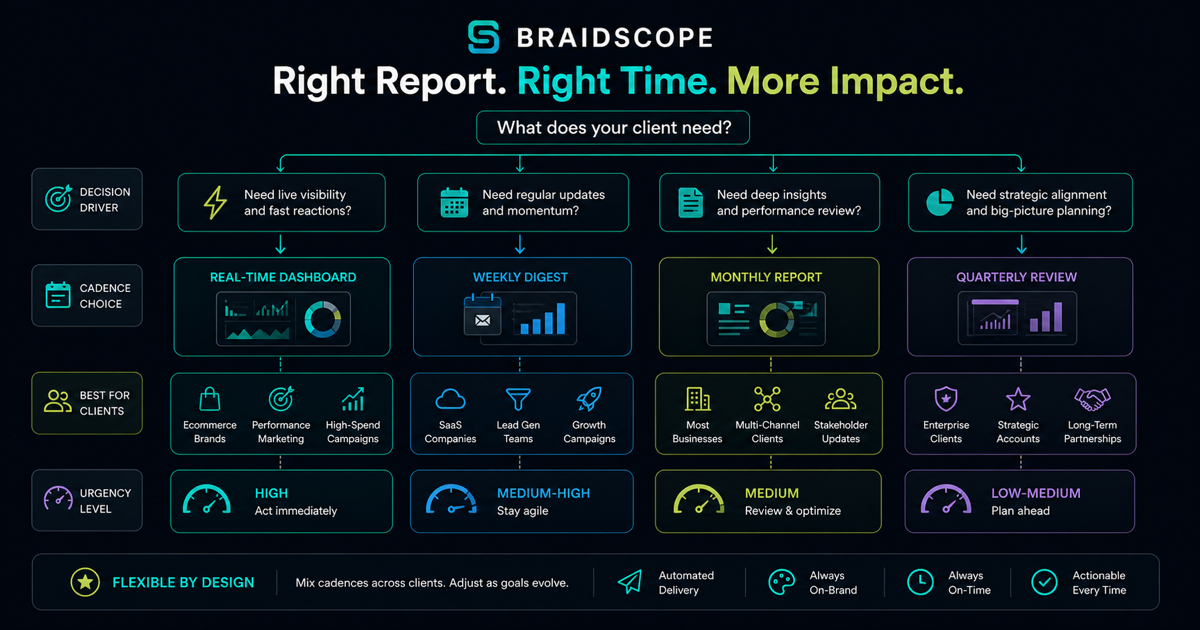
The best cadence depends on the service, the client, and the decisions the report supports.
Quick takeaways
- Report as often as the client needs to make or trust a decision.
- Paid media usually needs a weekly pulse, while SEO and content usually need monthly analysis.
- The right cadence prevents surprises and reduces anxious check-in messages.
The simple rule
Report as often as the client needs to make or trust a decision.
Paid media needs tighter reporting because spend changes daily. SEO can breathe because results move slower. A founder watching his own store may want a weekly pulse. A CEO may only need a monthly summary unless something breaks.
This is why there is no universal cadence. There is only the cadence that matches the risk, spend, and speed of the channel.
The three reporting cadences
Most agencies need three types of reporting:
- weekly pulse
- monthly deep-dive
- real-time dashboard
Each one has a different job.
Weekly pulse
A weekly pulse is short.
It should answer:
- what happened this week?
- did anything change materially?
- are we on track?
- what are we doing next?
Weekly reporting is best for paid media, ecommerce, launches, high-budget campaigns, and clients who need fast visibility.
It works especially well through Slack or email.
Monthly deep-dive
A monthly report is more strategic.
It should explain:
- trend over the month
- what worked
- what did not
- why performance changed
- what happens next month
Monthly reporting is best for SEO, content, brand, CRM, and strategic retainers.
For structure, read our guide on monthly marketing reports.
Real-time dashboard
A real-time dashboard gives async access.
It is useful for clients who ask for numbers between meetings, executives who want visibility, and agencies that want fewer “can you send the latest report?” messages.
But a dashboard does not replace interpretation. It supports it.
Our multi-client dashboard guide explains how to set this up without creating dashboard chaos.
Set expectations during onboarding
Do not decide cadence after the first month.
Set it during onboarding:
- who receives the report?
- what format do they prefer?
- what decisions should it support?
- what is the weekly versus monthly expectation?
- when does the report go out?
This prevents reporting surprises later.
What happens when you miss cadence
Clients rarely complain the first time.
But they notice.
Inconsistent reporting makes the agency feel reactive. It also creates anxiety during bad performance periods.
Automation helps because it removes memory from the process.
What a business owner actually wants
Most business owners do not want more reports. They want fewer surprises.
If performance is stable, a short summary is enough. If spend is rising, conversion tracking breaks, or revenue drops, they want to know quickly.
That means your cadence should include exception reporting. The client should not wait until the monthly call to learn that a key metric broke two weeks ago.
Automate the send
Braidscope is built so reports can go out through Slack or email after data sources are connected.
Your team can still add strategy and commentary, but the recurring reporting system should not depend on manual reminders.
Bottom line
The right reporting frequency is the one that supports decisions without overwhelming the client.
If you want dashboards, weekly pulses, and monthly reports that do not depend on manual work, join the Braidscope closed beta and lock in founder pricing before launch.