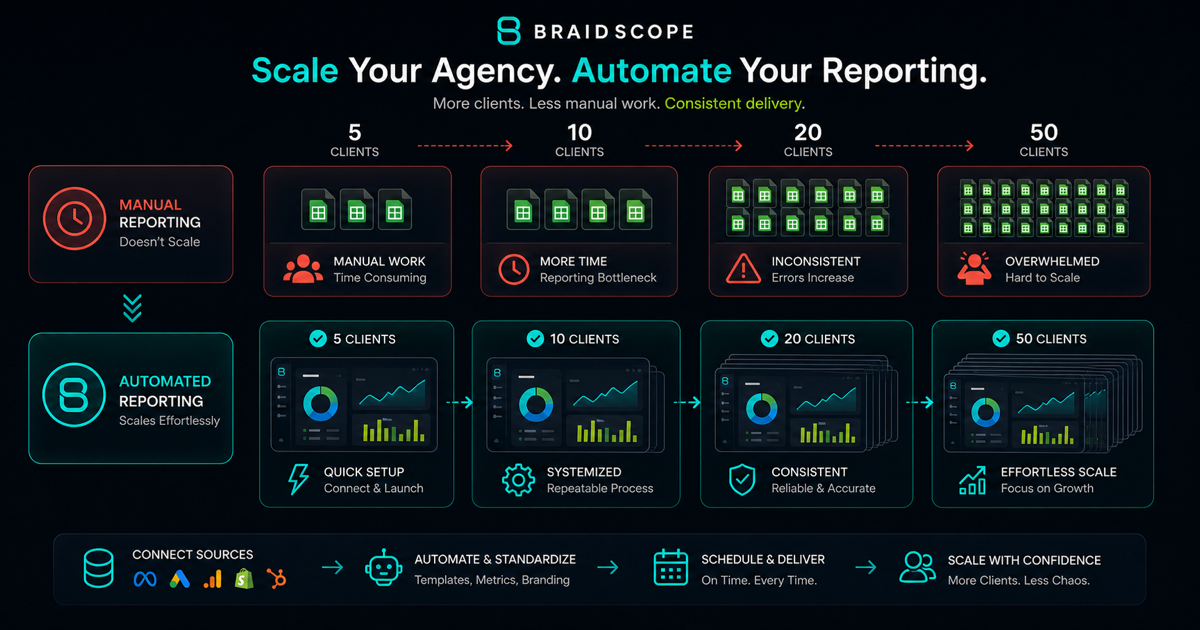
Most agency scaling problems are delivery problems wearing a sales mask.
The agency can close more clients. The team can do the work. But reporting, communication, and client management start eating the margin.
At 10 to 15 clients, the bottleneck often becomes reporting.
Quick takeaways
- Many agency scaling problems are delivery problems, and reporting is often the hidden bottleneck.
- Standardize the reporting package before you try to automate it.
- A leadership dashboard should show which clients need attention, not only campaign metrics.
The founder version of this problem
The same ceiling appears inside founder-led companies.
At first, the founder checks every platform personally. Then more channels get added. Meta, Google, Shopify, GA4, HubSpot, email, Sheets, social analytics. Eventually the founder is not making better decisions, he is just opening more tabs.
Scale requires a central view, whether you are managing clients or managing your own company.
The ceiling growing agencies hit
A small agency can survive on heroic effort.
The founder knows every client. Account managers remember every detail. Reports get made manually because there are only a few of them.
Then the agency grows.
Fifteen clients need weekly or monthly reporting. Each client has different sources, different goals, different dashboards, and different questions.
The team starts spending more time proving the work than doing the work.
The math is painful
If each client takes 3 hours per month to report, 15 clients take 45 hours per month.
That is more than a full workweek.
If each client takes 1 hour per week, 15 clients take 60 hours per month.
That is a part-time reporting role hiding inside your delivery team.
This is why agencies feel busy before they feel profitable.
The three levers
Scaling delivery usually comes down to three levers:
- Standardize
- Templatize
- Automate
You need all three.
Standardize the reporting package
Do not sell a completely different reporting experience to every client.
Create standard packages:
- weekly paid media pulse
- monthly ecommerce report
- SEO monthly growth report
- executive dashboard
- Slack digest plus live dashboard
The client can have different metrics, but the reporting structure should be repeatable.
Templatize the dashboard
The dashboard should not be reinvented for every account.
Use the same structure for similar clients:
- paid media overview
- ecommerce revenue view
- SEO performance view
- CRM pipeline view
This is the core idea behind a multi-client dashboard guide.
Automate collection and delivery
Automation should remove the repetitive work:
- pulling data
- updating charts
- sending summaries
- generating recurring reports
- alerting on anomalies
Your team should handle strategy, interpretation, and client communication.
Braidscope is built for this exact scaling problem. One workspace per client, automatic dashboards when sources are connected, AI answers, and Slack or email delivery.
What to do with the saved time
Do not only use saved reporting time to take on more clients.
Use it to improve delivery:
- better strategy calls
- deeper creative analysis
- faster experiments
- stronger onboarding
- proactive client communication
That is how reporting automation turns into retention, not just efficiency.
The leadership dashboard
As the agency grows, the owner needs a different dashboard than the account manager.
The owner view should show:
- client health
- reporting status
- accounts needing attention
- revenue or lead movement by client
- broken data connections
- upcoming reports
That view helps leadership manage the business instead of waiting for problems to surface in Slack.
Bottom line
To scale a marketing agency, you need a delivery system that does not depend on manual reporting heroics.
If reporting is limiting your growth, join the Braidscope closed beta and lock in founder pricing before launch.