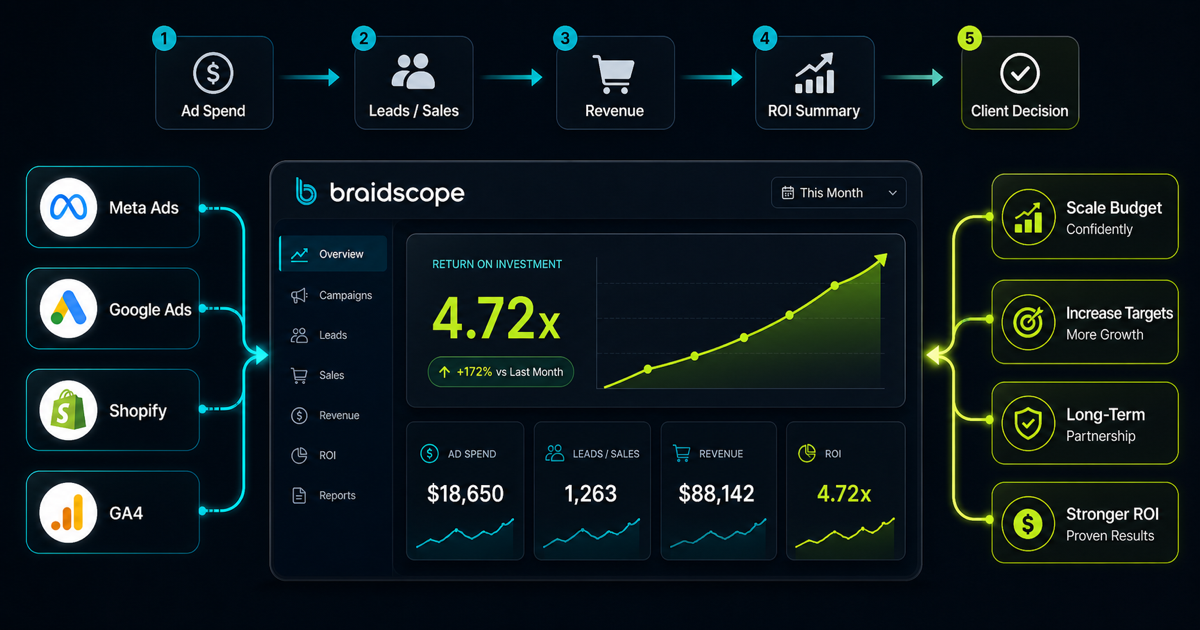
ROI is the number clients care about most.
They may ask about impressions, clicks, rankings, and engagement, but the real question is whether marketing is creating enough business value to justify the spend.
The agency’s job is to measure ROI honestly, explain uncertainty clearly, and connect work to outcomes.
Quick takeaways
- ROI reporting should answer whether spend created enough business value to continue.
- Not all attribution has the same confidence, so label what is certain and what is directional.
- The client should understand the rule for measuring ROI before campaigns begin.
What ROI sounds like to a normal buyer
A business owner usually does not use the phrase “attribution model” in everyday conversation.
He asks simpler questions:
- Did we make money?
- Are leads good?
- Is the spend too high?
- Should we keep going?
Your ROI report should answer those questions before it explains the technical caveats.
The ROI problem
Marketing attribution is rarely clean.
Paid search may capture demand created by social. SEO may assist a conversion that closes through direct traffic. A client may close deals offline. Tracking may miss calls, referrals, or repeat purchases.
That does not mean you ignore ROI. It means you define the rules before reporting it.
Set up ROI tracking before work starts
Before campaigns begin, define:
- what counts as a conversion
- what counts as qualified
- how revenue is tracked
- which source of truth is used
- attribution window
- reporting cadence
If the client does not agree on these upfront, every report can become a debate.
This is why reporting belongs in onboarding, not just delivery.
What counts as revenue attribution
For ecommerce, Shopify revenue can be the source of truth, with Meta Ads and Google Ads used for platform-level context.
For lead generation, CRM pipeline and closed won revenue matter more than raw leads.
For SaaS, qualified trials, demos, pipeline, and paid conversions may all matter.
For local services, calls, bookings, and closed jobs may need offline tracking.
Channels where ROI is harder
SEO, content, brand, and organic social often influence revenue without getting clean last-click credit.
For these channels, report:
- assisted conversions
- organic conversion trends
- search visibility
- branded search lift
- qualified traffic
- pipeline influenced
Be honest about attribution limits. Clients trust clear caveats more than exaggerated certainty.
The reporting framework
Use this format:
- Spend
- Result
- Return
- Interpretation
- Next action
Example:
“We spent $8,000, generated $31,000 in tracked revenue, and delivered 3.9x ROAS. Revenue came mostly from retargeting, while prospecting is still below target. Next month we are refreshing creative and reducing budget on the weakest audience.”
Handling the “we do not see results” conversation
Do not argue with the client emotionally.
Walk through:
- the agreed success metric
- the data source
- what improved
- what declined
- what is uncertain
- what action you recommend
Bad reporting makes this conversation defensive. Good reporting makes it practical.
Automating ROI reporting
ROI reporting usually requires combining ad spend, analytics, store revenue, and CRM data.
That is why manual spreadsheets become fragile.
Show confidence levels
Not every ROI number deserves the same confidence.
Use simple labels:
- High confidence: Shopify revenue, closed won CRM revenue, tracked purchases
- Medium confidence: platform-attributed revenue, assisted conversions
- Lower confidence: brand lift, content influence, view-through attribution
This helps clients trust you because you are not pretending every number is equally certain.
Braidscope is built to connect sources like Meta Ads, Google Ads, GA4, Shopify, HubSpot, and Google Sheets so agencies can see client performance in one place.
For more on building this system, read how to automate client reporting.
Bottom line
Proving ROI is not about pretending attribution is perfect. It is about setting the rules, showing the best available data, and explaining what it means.
If you want cleaner ROI dashboards and automated client reports, join the Braidscope closed beta and lock in founder pricing before launch.