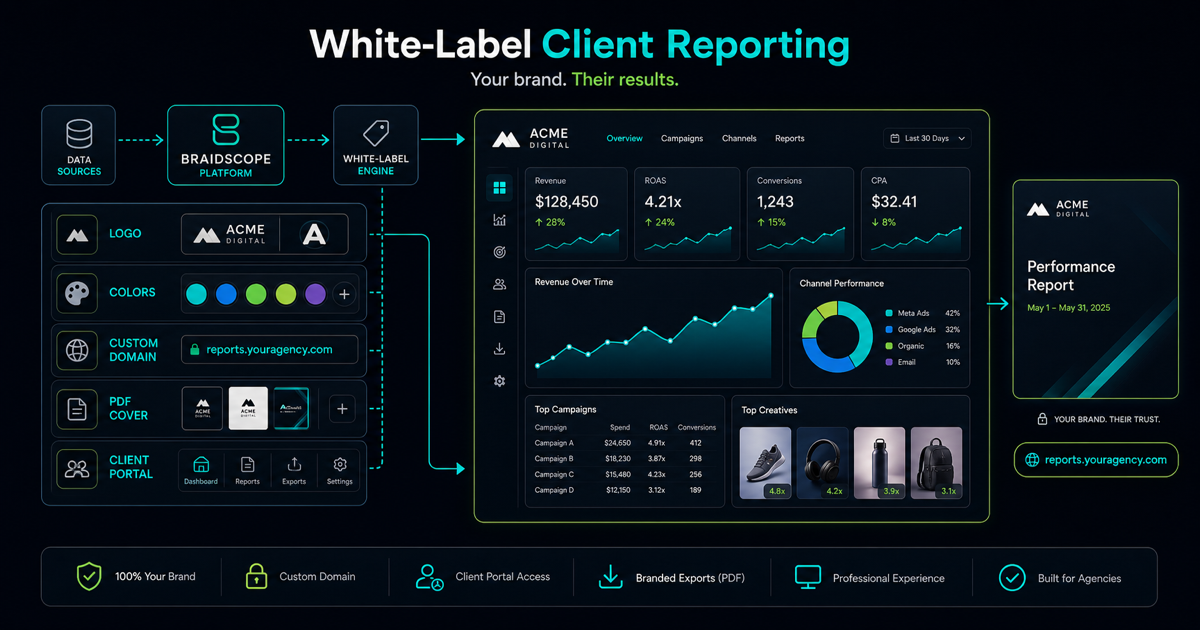
White-label reporting means the client sees your agency brand, not the software behind the report.
That sounds simple, but agencies often overpay for white-label features while ignoring the harder problem: the report still takes too long to build.
Branding matters. But branded manual work is still manual work.
Quick takeaways
- White-label reporting helps the agency look organized, but it cannot fix unclear reporting.
- Branding matters most when reports are part of the client’s perceived service experience.
- Fix accuracy, cadence, and recommendations before worrying about logos and custom domains.
The buyer perception issue
White-label reporting is not about hiding software. It is about making the agency feel organized and accountable.
A founder may not care about white-labeling at all if the dashboard is only internal. A business owner paying an agency does care, because reporting is part of the agency’s perceived service.
The report should feel like it came from the team responsible for the work.
What white-label reporting actually means
A white-label client report usually includes:
- your agency logo
- your brand colors
- a custom report domain or portal URL
- PDF cover pages
- branded email delivery
- no third-party tool branding
- client access that feels like your agency experience
The purpose is simple. The client should feel like reporting is part of your service, not something outsourced to a random tool.
Why white-label reporting matters
For retainer clients, reporting is one of the most visible parts of your service.
They may not see every campaign optimization or technical fix. They do see the report every week or month.
When that experience is branded, clean, and consistent, it reinforces the agency relationship.
White-label reporting also helps with premium positioning. If you charge serious retainers, sending a messy spreadsheet or generic dashboard link weakens the perceived value.
What agencies get wrong
The biggest mistake is treating white-label as the main feature.
A report can have your logo and still be late. It can use your colors and still confuse the client. It can have a custom domain and still require two hours of manual updates.
White-label is useful only after the reporting workflow works.
The better order is:
- standardize report structure
- automate data pulling
- automate delivery
- add plain-English interpretation
- apply white-label branding
If you skip the first four, you are just putting nicer packaging around a broken process.
Features to look for
A good white-label reporting tool should include client workspace isolation. Each client should see only their own data.
It should support custom branding without requiring a designer every time.
It should offer client portals or live dashboard links.
It should automate report delivery through email or Slack.
It should let your agency standardize reporting across clients while still keeping each report relevant.
Most importantly, it should reduce setup time. If every new client still requires a dashboard rebuild, white-label does not solve the operational pain.
Tool comparison
| Tool | White-label support | Best fit | Main tradeoff |
|---|---|---|---|
| Braidscope | Yes | Multi-client agencies | Closed beta |
| AgencyAnalytics | Yes | Mature reporting teams | Per-client pricing |
| DashThis | Partial to strong | Simple dashboards | Limited AI |
| Whatagraph | Strong | Visual reports | Higher cost |
| Looker Studio | Manual | DIY teams | No native agency portal |
Where Braidscope fits
Braidscope includes white-label client portals, but the bigger value is the workflow behind them.
Each client gets an isolated workspace. When you connect sources like Meta Ads, Google Ads, Shopify, GA4, HubSpot, or Google Sheets, dashboards appear automatically. Your team does not rebuild the dashboard from scratch.
Then AI answers and automated Slack or email reports help your team explain the data faster.
That means the branded experience is not just prettier. It is easier to operate.
For a deeper view of the operating model, read our multi-client dashboard guide.
When white-label is worth paying for
White-label reporting is worth it when:
- clients are on monthly retainers
- reports are part of your perceived value
- clients share reports internally
- your agency sells premium strategy
- you want reporting to feel owned by your agency
It is less important if you have a few small clients, mostly internal reporting, or a highly technical client base that does not care about branding.
Do not let branding cover weak reporting
White-labeling can make a good report feel premium.
It cannot make a weak report useful.
If the report is late, unclear, or missing recommendations, the logo will not save it. Fix clarity first. Brand second.
Bottom line
White-label reporting is useful, but it is not the whole system.
Your agency needs reports that are accurate, automated, clear, and on time. Then branding makes the experience feel like yours.
If you want white-label reporting without rebuilding dashboards for every client, join the Braidscope closed beta and lock in founder pricing before launch.