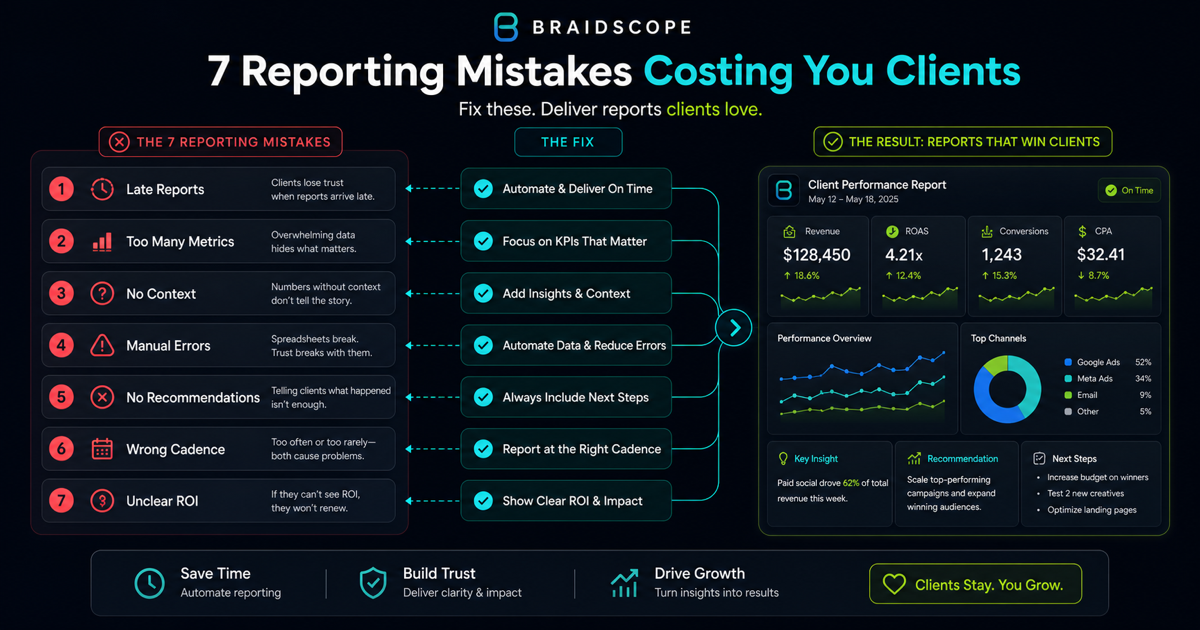
Agencies rarely lose clients in one dramatic moment.
Trust usually fades slowly. The client does not understand performance. Reports arrive late. Numbers need explaining every week. The agency sounds reactive instead of in control.
Reporting is one of the easiest places to lose trust. It is also one of the easiest places to fix it.
Quick takeaways
- Bad reporting can make good work look weak because clients judge what they can see.
- The biggest mistakes are late reports, raw data without context, and no recommendation.
- Standardize the format, automate the repeatable work, and keep the interpretation human.
How this feels to the client
From the agency side, reporting can feel like a deliverable.
From the client side, reporting feels like control.
A normal business owner in the US is not reading your report to admire the charts. He is asking whether the money he spent this month made sense. If the report makes him feel more confused, the agency loses trust even if the campaigns are improving.
That is why the fix is not more screenshots. It is clearer communication.
Mistake 1: Reporting on agency activity instead of client outcomes
Clients do not care that you optimized campaigns if they cannot connect that work to the business.
Activity metrics are useful internally. Client-facing reports should lead with outcomes:
- revenue
- leads
- pipeline
- ROAS
- CAC
- conversion rate
- qualified opportunities
Put activity in the “what we did” section, not the headline.
Mistake 2: Sending reports late
Late reports create doubt.
Even if the performance is good, a late report makes the client wonder what else is being missed.
The fix is cadence. Pick a weekly, monthly, or real-time reporting rhythm and stick to it. Better yet, automate the send so reporting does not depend on someone’s calendar.
Our guide on how to automate client reporting explains the layers you need.
Mistake 3: Not including a recommendation
A report without a recommendation puts the work back on the client.
If the report shows lower ROAS, what should happen next? If leads increased but quality dropped, what is your plan? If SEO traffic is flat, what changes next month?
Every report should include one clear recommendation.
Mistake 4: Dumping raw data without context
Raw data creates more questions than answers.
Context means explaining the number against a target, previous period, benchmark, or business goal.
Bad:
“Cost per lead was $84.”
Better:
“Cost per lead rose from $62 to $84 because we expanded into a colder audience. Lead quality improved, so we are keeping the test live for one more week before reallocating budget.”
Mistake 5: Building a different format for every client
Customization feels helpful at first. Then it becomes a trap.
If every client has a different reporting format, your team cannot scale. Every report becomes a custom project.
Standardize the structure. Customize the metrics and interpretation.
That is the operating idea behind a multi-client dashboard guide: one system, many client workspaces.
Mistake 6: Making clients log into tools they will never learn
Clients do not want homework.
If your client portal is confusing, they will stop using it. If the dashboard has too many filters, they will ask you for screenshots instead.
Give clients simple read-only access with the few metrics they actually care about.
Mistake 7: Manually pulling data every week
Manual reporting burns teams.
It also creates errors. One missed filter, one wrong date range, or one outdated spreadsheet can damage confidence.
Manual work is fine for a small agency with 1 to 3 clients. It becomes expensive once you manage 5, 10, or 20 clients.
Mistake 8: Sounding like software instead of a person
Some reports are technically correct and still painful to read.
They say things like “performance saw a positive directional increase across core KPIs.” A client reads that and immediately knows nobody talks like that.
Write like a calm operator:
“Revenue improved 12%. The lift came from retargeting. Prospecting is still below target, so we are not increasing spend there yet.”
That tone feels more trustworthy because it sounds like a person who understands the account.
The fix: standardize and automate
The fix is not more reporting effort. It is a better reporting system.
Standardize:
- report structure
- metrics per service line
- delivery cadence
- client dashboard layout
Automate:
- data collection
- dashboard updates
- email or Slack delivery
- recurring summaries
Then use human judgment for the interpretation and recommendation.
Where Braidscope fits
Braidscope is built for agencies that want to remove the repetitive reporting work.
You create one workspace per client, connect their sources, and dashboards appear automatically. AI answers help explain performance changes. Reports can be delivered through Slack or email.
That means your team spends less time pulling data and more time advising clients.
Bottom line
Bad reporting makes good work look weak. Good reporting makes the agency feel organized, strategic, and trustworthy.
If you want to standardize client reporting and stop rebuilding dashboards by hand, join the Braidscope closed beta and lock in founder pricing before launch.