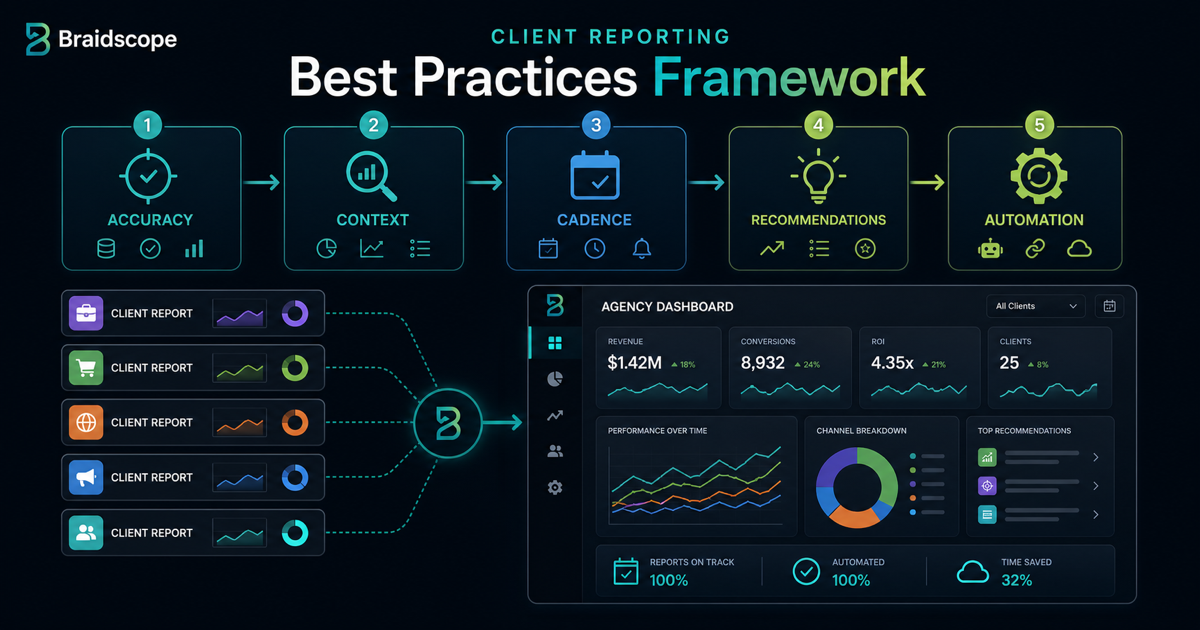
Client reporting is not admin work. It is retention work.
Most agencies lose trust slowly. The work may be fine, but the client does not understand what changed, why it changed, or what happens next. Reporting is where that trust either compounds or leaks away.
These are the client reporting best practices we recommend for agencies that want reports clients actually read.
Quick takeaways
- Good reporting is a retention tool, not an admin task.
- Clients need outcomes, context, and recommendations before they need detailed tables.
- The report should be easy for a busy owner to understand in five minutes.
The human test
Before sending any report, ask one question:
“Would a busy business owner understand this in five minutes?”
If the answer is no, the report is probably too agency-centric.
The best reports work for multiple readers. The account manager sees enough detail to explain performance. The founder sees what needs attention. The business owner sees whether the company is moving in the right direction.
1. Report by outcome, not activity
Clients do not pay for activity. They pay for outcomes.
A report that says “we launched 12 ads, published 4 posts, and optimized 3 campaigns” may be true, but it does not answer the client’s real question: did this help the business?
Lead with outcomes:
- revenue
- leads
- qualified pipeline
- cost per acquisition
- ROAS
- conversion rate
- customer acquisition cost
Activity belongs later in the report as context.
2. Cadence matters more than format
A simple weekly report sent every Friday builds more trust than a perfect report sent randomly.
Clients should know when they will hear from you. Reporting cadence becomes part of the service promise.
Paid media and ecommerce clients usually need a weekly pulse plus a monthly deep-dive. SEO and content clients usually need a monthly report because results take longer to mature.
If you are still deciding cadence, read our guide on how to automate client reporting so delivery does not depend on someone remembering to send the report.
3. Use one main number per section
Too many reports are full of metric soup.
Every section should have one main number and supporting context. For example:
- Paid media: ROAS
- Lead generation: cost per qualified lead
- Ecommerce: revenue and MER
- SEO: organic conversions
- Email: revenue per campaign
The supporting metrics explain the main number. They should not compete with it.
4. Add benchmarks and context
A number without context creates anxiety.
If ROAS is 2.4x, is that good or bad? It depends on margin, previous performance, channel, seasonality, and campaign stage.
Always compare against:
- previous period
- target
- baseline
- client goal
- known benchmark
Context is what turns reporting into strategy.
5. Automate delivery so it never slips
Late reports damage trust. Even when results are good, late reporting makes the agency look disorganized.
Automated delivery removes that risk. The report should go out even if an account manager is busy, sick, or buried in client work.
Braidscope is built around this idea. Dashboards update automatically, and reports can be delivered through Slack or email so your team spends time on interpretation instead of chasing data.
6. Put the plain-English summary before the data
Start every report with:
- what happened
- why it happened
- what we are doing next
Then show the data.
Most clients do not want to decode dashboards. They want to know whether they should be confident, concerned, or making a decision.
7. Give clients async access
Some clients want to check numbers between calls. Give them a client portal or dashboard link so they can self-serve.
This reduces “can you send me the latest numbers?” messages.
But do not make the client learn a complex tool. The dashboard should be simple, read-only, and organized around their goals.
8. Discuss reporting during onboarding
The reporting relationship starts in the kickoff call.
Ask:
- What does a good month look like?
- Which metrics does leadership care about?
- Who reads the report?
- Do you prefer Slack, email, dashboard, or call review?
- What decisions should the report help you make?
These answers shape the report. Without them, the agency guesses.
Common reporting mistakes
The most common mistake is reporting on what the agency controls instead of what the client cares about.
Another mistake is changing the report format every month. That makes it hard for the client to learn the rhythm.
The third mistake is sending raw data without a recommendation. A report should end with a point of view.
The fourth mistake is rebuilding a different format for every client. That does not scale. Use a standard structure and customize only the metrics that matter.
Our multi-client dashboard guide explains how to standardize without making reports feel generic.
What good looks like
A strong client report has this structure:
- Executive summary
- Main KPI performance
- What changed
- Why it changed
- Channel details
- Risks or blockers
- Recommendation
- Next actions
That structure works because it answers the client’s questions in order.
What makes it feel non-robotic
A report feels human when it has a point of view.
Instead of:
“Traffic increased 14% month over month.”
Write:
“Traffic increased 14%, but the useful part is that demo requests increased too. The lift came mostly from paid search, so we are moving next month’s budget toward the highest-intent campaign.”
That is the difference between a dashboard export and an agency report.
Bottom line
Good reporting is not about more charts. It is about clarity, consistency, and trust.
If your agency wants to standardize reporting, automate delivery, and give every client a clear dashboard without rebuilding from scratch, join the Braidscope closed beta and lock in founder pricing before launch.